
All posts
Published
October 30, 2025

Analyzing Indonesia’s Future Under Prabowo-Gibran Administration: What Lies Ahead?

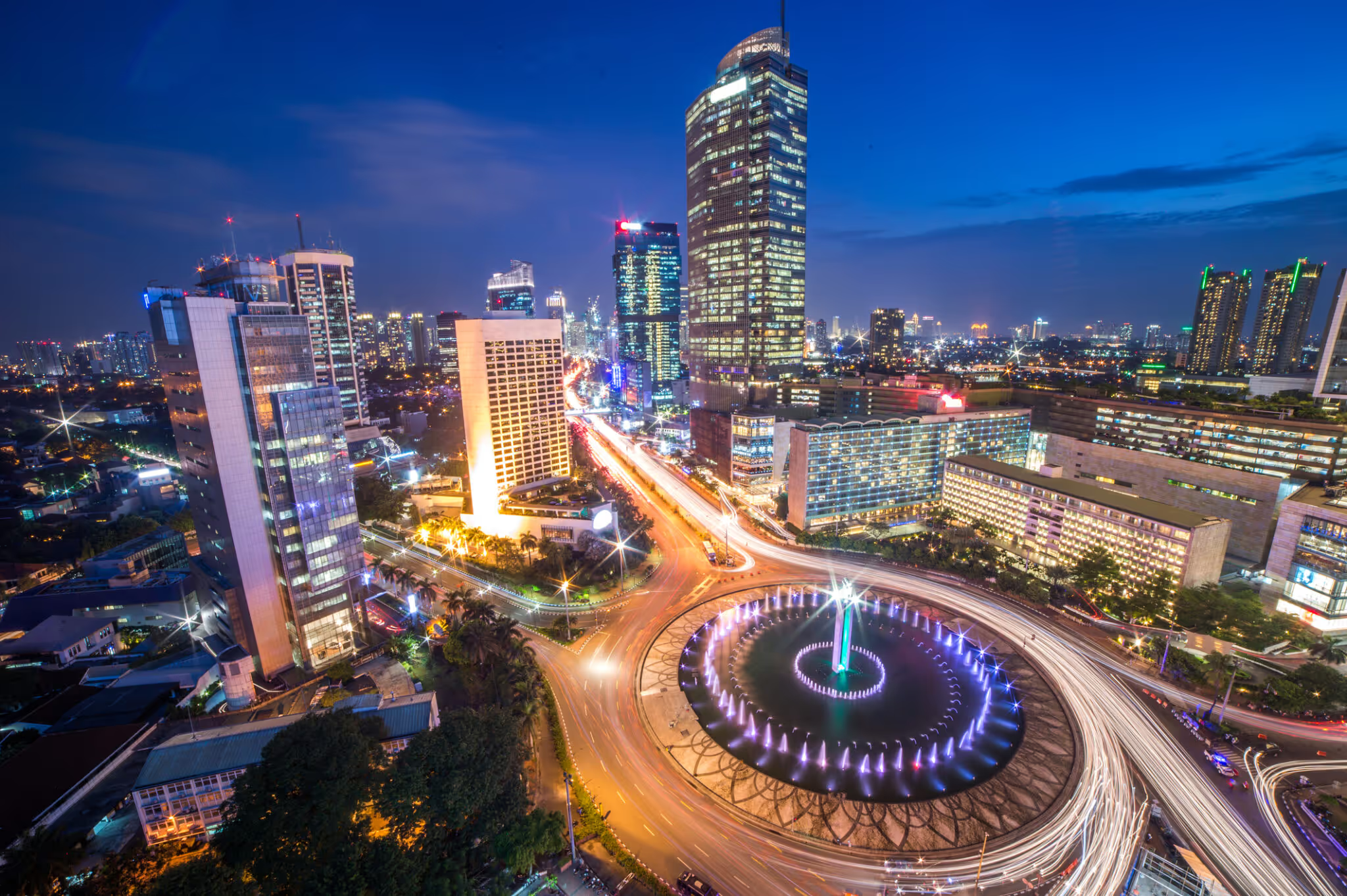
Prabowo Subianto’s presidency is expected to maintain democratic stability with a firmer, more centralized leadership style. His government will likely emphasize Indonesia-first policies, increased international presence, and economic continuity with potential shifts based on cabinet composition. Speyside Asia Pacific analyzes the corporate affairs challenge in this high-growth market.

Prabowo Subianto’s presidency is expected to maintain democratic stability with a firmer, more centralized leadership style. His government will likely emphasize Indonesia-first policies, increased international presence, and economic continuity with potential shifts based on cabinet composition. Speyside Asia Pacific analyzes the corporate affairs challenge in this high-growth market.

The General Election Commission (KPU) has announced the victory of Prabowo Subianto-Gibran Rakabuming Raka as the elected President and Vice President on 20 March, 2024.  What does this mean for Indonesia moving forward?

In brief, under Prabowo’s leadership, Indonesia is likely to continue on its democratic path with stable governance but may adopt a more assertive approach. The former military general is known for his candor, with his governing style reflecting a more rigid and bureaucratic approach. This implies that, unlike Jokowi’s pragmatic, action-oriented style, Prabowo would likely heavily rely on his support team to drive strategic goals. Prabowo is also expected to continue Jokowi’s “Indonesia-first policies,” with a focus on garnering greater respect for Indonesia in the global community. Nevertheless, his extensive international exposure and experience in engaging with state leaders and the international community suggest that his presence on the international stage will likely be more prominent than that of the current administration.

In the economic sector, the campaign team has outlined 21 commodities for the expansion of the downstream agenda, including technology, and has prioritized establishing the National Revenue Institution to bolster Indonesia’s tax ratio. However, potential implications for business operations, such as increased restrictions and scrutiny, as well as the rising cost of doing business and other compliance costs, may arise if these policies are not carefully formulated and implemented. Nevertheless, while the emphasis on continuity from the previous administration is evident, the intricate web of factions vying for influence over economic policy suggests a nuanced approach ranging from nationalist-driven agendas to pro-business orientations. As such, instead of being influenced by a single faction, the composition of Prabowo’s economic team and cabinet appointments will likely encompass a mix of the spectrum, requiring extensive understanding of the key figures and their objectives to navigate Indonesian economic policies going forward.

So, who do you think will comprise the cabinet under Prabowo-Gibran? Share your thoughts with us!

#Indonesia #Indonesia2024 #PrabowoGibran #Politik #Ekonomi

Conclusion

Indonesia under Prabowo-Gibran will likely experience policy continuity in key areas but with stronger central control and strategic assertiveness. The cabinet's final makeup will be crucial in defining the balance between nationalist and pro-business influences, and businesses should closely monitor appointments to understand future regulatory and economic directions.
Our Story

View All News
Latin America

One Left, Two Rights: Colombia’s 2026 Election and What Investors Should Watch

The Speyside Latin America team provides a strategic perspective on the high ideological stakes of Colombia’s 2026 Election, framed by the tension of One Left, Two Rights. As the country enters a decisive stage, the race is defined by a genuine choice between competing models for the state, the economy, and the energy transition. On the right, the field is split between Paloma Valencia—the standard-bearer for the Gran Consulta por Colombia coalition—and Abelardo de la Espriella, an independent candidate with significant digital reach. Meanwhile, the left advances Iván Cepeda as the successor to the current administration's orientation.
Read post
Public Affairs

Navigating CEE Business amid the EU’s New Competitiveness Focus

The Speyside Central and Eastern Europe team is closely monitoring the intensifying debate around the European Union’s competitiveness agenda and the emerging concept of “Buy European” or “European preference.” For business, this debate is no longer a distant Brussels policy discussion but an emerging framework that will shape future market access, public funding, regulatory burdens and industrial opportunities across the EU. With the growing focus on economic sovereignty, MNCs may face pressure to localise production and adjust supply chains to align with EU priorities.
Read post
APAC

ASEAN’s Energy Transition Realities

The Asia Pacific Speyside team analyzes ASEAN's Energy Transition Realities, assessing how geopolitical Disruption is forcing a pivot toward regional Resilience. With global conflicts disrupting roughly 20% of global oil flows, Southeast Asia is reframing its energy transition as a critical national security imperative rather than solely an emissions-reduction effort. To mitigate reliance on imported fossil fuels, the ASEAN Power Grid (APG) has emerged as an operational and financing priority, aimed at connecting national electricity systems and diversifying power supplies through cross-border renewable energy trade.
Read post