
What’s happening?
On June 2, Claudia Sheinbaum (MORENA-PT-PVEM) was elected the first female president in Mexico’s history, for the 2024-2030 term. By a margin of 30%, her victory was resounding. The surprise was not the victory itself, but the margin by which she won. This can be seen as an endorsement of López Obrador’s government and the policies implemented during his administration.
According to preliminary results, Sheinbaum received between 58.3% and 60.7% of the vote, becoming the most popular candidate in the history of presidential elections. Xóchitl Gálvez, the runner-up, received between 26.6% and 28.6% of the vote. In addition, out of the 9 governorships contested, MORENA won 7: Mexico City, Chiapas, Morelos, Puebla, Veracruz, Tabasco and Yucatán.
The MORENA-PT-PVEM coalition will govern 24 of the 32 states (75%). PAN will govern 4, PRI 2, and MC 1.
While Xóchitl Gálvez conceded defeat on election day, she announced her intention to challenge the results the following day, citing an unfair campaign in which state resources were allegedly used to favor her opponent. Regardless of the outcome of these challenges, several factors have been identified that explain Sheinbaum’s decisive victory.
A key reason for this is that President López Obrador has been responsive to the needs of the population and has implemented policies that have benefited a broad cross-section of society. Under his administration, many Mexicans have seen their incomes rise and poverty rates fall. In particular, the minimum wage has increased significantly, and the controversial outsourcing program has been abolished. López Obrador has also expanded pension programs and increased the number of mandatory holidays for workers. These policies resonated with the electorate, providing tangible benefits and improving the quality of life for many, which in turn bolstered support for Sheinbaum as his successor.
Under the López Obrador administration, several constitutional reforms failed to advance due to a lack of votes in Congress, and reforms to secondary legislation were struck down by the nation’s Supreme Court. However, the recent election results suggest that the new president will have sufficient support in the legislature to pass any reforms deemed necessary. This shift suggests a more streamlined legislative process, allowing the new administration to implement its agenda with greater efficiency and less opposition.
Congressional composition
The National Regeneration Movement (MORENA) and its allies, the Labour Party (PT) and the Ecologist Green Party of Mexico (PVEM), will have a qualified majority in the Chamber of Deputies and will be just a few seats short of a qualified majority in the Senate. If they secure these additional seats, they could amend or even draft a new constitution.
Given that Sheinbaum takes office on October 1 and the LXVI legislature begins in September, there is still room for López Obrador to pass legislation before he leaves office. Indeed, on June 3, during his morning conference, López Obrador stressed the importance of reaching an agreement with Claudia Sheinbaum on the constitutional reforms to be promoted in September, before his term ends.
In the charts below we show the possible composition of the Chamber of Deputies and the Senate for the new term. The first graphic shows the distribution of seats in the Chamber of Deputies between the parties and the threshold for a qualified majority (334 seats) needed to approve constitutional reforms. The second chart shows the potential composition of the Senate, with Morena very close to a qualified majority.
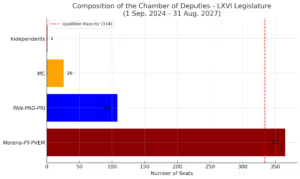
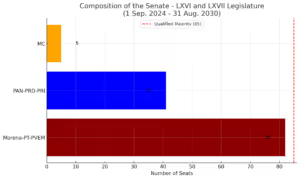
Source: Elaboration based on data from the Ministry of the Interior announced on June 3rd based on information from the National Electoral Institute (INE).
Key takeaways from the election results
- Increased Presidential Power. Claudia Sheinbaum will have more concentrated power than the current president, López Obrador.
- Opposition’s Role. The opposition parties will have limited ability to block legislative proposals or pass new ones on their own.
- Legislative Transition. The new legislature will start on September 1, while the new president will take office the first day of October. This means the current president retains legislative influence until then. In fact, on June 3, during his morning conference, López Obrador highlighted the importance of agreeing with Claudia Sheinbaum on the constitutional reforms to be promoted in September before his term concludes.
Policy Continuation and Changes
- Sheinbaum has pledged to continue López Obrador’s policies on austerity, gender equality, citizen non-repression, and defending Mexicans abroad.
- Her political model recognizes free trade with state participation to ensure prosperity, fair wages, and constitutional rights.
Economic Affairs
- In her acceptance speech, Sheinbaum stated that she will respect business freedom, promote private investment, and ensure environmental protection.
- She seeks to promote and leverage investment stemming from ‘nearshoring’ together with the private sector.
- Sheinbaum aims to continue López Obrador’s strategic projects, including the Interoceanic Corridor of the Isthmus of Tehuantepec, the Mayan Train, and the Dos Bocas Refinery.
- She seeks to create 100 industrial parks in the 12 development poles formerly promoted by President López Obrador, seizing local productive vocations (skilled workforce, local suppliers, natural resources, connectivity, etc.).
- In the case of relations with the United States, the President-elect wants to maintain a ‘relationship of equals’ with the US government.
- As part of her Presidential campaign, she engaged with representatives from the private sector to gather their insights in preparation for the review of the US-Mexico-Canada Free Trade Agreement, which will take place in 2026.
- Claudia Sheinbaum’s main advisors in this context are the former Mexican representative to the United Nations, Juan Ramón de la Fuente; the former Secretary of Foreign Affairs, Marcelo Ebrard; and private sector leader, Altagracia Gómez.

Some experts expect Claudia Sheinbaum to distance herself from President López Obrador to signal her independence. Her administration is also expected to take a more technocratic approach. However, it remains to be seen whether her administration will be a disciplined continuation of López Obrador’s vision. For now, her campaign promises include the following:
Fiscal Reform
- She has promised not to implement fiscal reforms or increase taxes in the early years of her administration, focusing instead on enhancing tax compliance.
Rogelio Ramírez de la O., the current Minister of Finance, was announced by President López Obrador to remain in his role during Sheinbaum’s administration.
Health
- The health policy focus is likely to be on strengthening the IMSS-Bienestar scheme and addressing deficiencies in distribution and availability of medicines through digitalization.
Security
- Continuation of judicial reforms and strengthening the National Guard, likely placing it under the National Defense Secretariat.
Energy
- Focus on energy sovereignty by reducing imports, strengthening state companies (PEMEX and CFE), investing $13.5 billion in new energy projects, and promoting clean energy to reduce energy intensity and emissions. However, a protectionist energy policy is likely to be implemented.
Conclusion
Claudia Sheinbaum’s presidency signals a powerful political continuity in Mexico, backed by a strong congressional majority. Her administration will likely maintain López Obrador’s core policies, while introducing a more technocratic and potentially independent leadership style. With strategic projects, a focus on nearshoring, and pledges to respect private investment, Sheinbaum aims to balance economic development with social welfare and state participation. However, the extent to which she carves her own path or follows her predecessor’s legacy will shape Mexico’s domestic and international standing in the coming years.


