
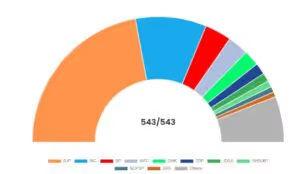
Prime Minister Narendra Modi’s alliance (NDA) declared victory in India’s general election, however Modi’s party will now need to rely on coalition partners to govern for the first time since 2014.
Modi’s anticipated landslide win – with talk of securing up to 370 seats for his party and 30 for his allies – failed to materialize.
Regional parties are now poised to have a significant impact on the formation of the government.
What impact will this have on politics and policy in India over the coming years?
Shifting Political Landscape
- Return of Regional Parties: With notable gains in states like Bihar, Jharkhand, Maharashtra, Uttar Pradesh, and West Bengal, strong regional parties are back, reversing declines in recent elections. The dominance of BJP in previous years had resulted in the fragmentation of several significant regional parties in Maharashtra and Bihar, but this has now reversed, and many will now look to the Assembly elections in Maharashtra in October 2024 to see if this was a one off or sustained trend.
- Emergence of Rahul Gandhi: Rahul Gandhi played a crucial role in the success of the Congress party in the election, securing 99 seats compared to 52 in 2019. Through his Bharat Jodo Yatra (Unite India March), he energized the grassroot organizations of the party. The march, spanning 10,000 kilometers, and predominantly conducted on foot, enabled Gandhi to directly engage with the public, positioning him as a significant competitor to Prime Minister Narendra Modi.
- Ram Temple Politics: Despite high expectations, the anticipated boost to the BJP’s performance following the inauguration of the Ram temple in Ayodhya did not materialize. Many experts had foreseen that this event would solidify the party’s position in Uttar Pradesh and other regions, but the strategy appeared to fall short. Unemployment and inflation were more important issues.
It’s noteworthy that the BJP faced defeat in Ayodhya, despite having fulfilled a campaign promise to construct the Ram Mandir at this site. This temple replaced a Mughal-era mosque from the sixteenth century that was demolished by Hindu groups in 1992. Ayodhya, considered one of Hinduism’s holiest sites, has been a focal point in Indian politics for decades.
In his first speech after the 2024 Lok Sabha results, Prime Minister Narendra Modi promised tough decisions in his third term, despite the BJP’s reduced numbers in Parliament.
Policy Agenda & Challenges for Modi’s Third Term
Given the shifting political landscape and parliamentary arithmetic, what might we expect in terms of the direction of policy in the coming years?
- Fiscal and Economic Policy: Prime Minister Modi’s reduced mandate may result in increased populist spending to bolster political support. Additionally, the July budget is expected to outline the government’s strategy for utilizing the Reserve Bank of India’s substantial Rs 2.11 lakh crore surplus transfer.This surplus could either be used to strengthen the fiscal position or to secure political backing.
- The increase in populist spending may lead to slip away from the fiscal deficit target in the short-term. However, the government is expected to return to fiscal consolidation in the medium term. The upcoming budget will provide more clarity on policy choices. The medium-term economic outlook continues to remain strong, given the solid economic fundamentals.
- Labor Laws: The Prime Minister is planning to introduce further business-friendly economic reforms, such as easing regulations on hiring and firing workers. Now within a coalition government, this may become more problematic and require compromise.
- Manufacturing: To fulfill an election pledge to transform India into a global manufacturing hub, Modi plans to offer subsidies for domestic production, similar to recent incentives for semiconductor and electric vehicle industries. We expect this as an immediate action by the NDA administration, possibly in the budget next month.
- Taxes: Modi also plans to reduce import taxes on key inputs for locally-made goods, which have pushed up India’s manufacturing costs. This could be one of the early announcements in the budget next month.
- Uniform Civil Code: All signs suggest that Modi 3.0 will lean on N Chandrababu Naidu and Nitish Kumar, both of whom are known for their secular stances bordering on minority appeasement. Building a consensus on the Uniform Civil Code (UCC) remains highly challenging.
- One Nation, One Election: A high-level committee led by former president Ramnath Kovind recommended certain constitutional amendments. Regional parties, including the Telugu Desam Party (TDP), oppose holding state and central elections simultaneously, fearing it could undermine their influence.
- Land reforms: One of the Modi government’s initial setbacks was its inability to build consensus for liberalizing land reforms in 2015, postponing the initiative until gaining a full majority. With a coalition government likely, the Modi administration will need to rely on states to maintain the momentum of India’s soaring economy and prevent any decline.
In summary, the outcome of the 2024 elections provides the Modi government with challenges but also opportunities to collaborate with regional parties, building a more inclusive, sustainable growth agenda. Critical to success, will be defining a new socio-economic agenda in the following areas:
- Job creation: Ensuring employment opportunities is vital not only for economic growth but also for social stability and individual well-being. By focusing on job creation, the new government can address unemployment rates, improve living standards, and harness the potential of India’s youth. This focus will be essential for fostering a prosperous and inclusive economy that benefits all citizens.
- Infrastructure Development: Accelerating infrastructure projects, particularly in transport, energy, and digital connectivity, to bolster economic growth, create employment opportunities, and enhance India’s overall competitiveness on the global stage.
- Investment and Employment Generation: Stimulating investment inflows, both domestic and foreign, and fostering an environment conducive to entrepreneurship and job creation to address the pressing issue of unemployment and drive inclusive growth across all sectors of society.
- Social Welfare and Health: Strengthening social welfare programs, prioritizing healthcare infrastructure, and ensuring access to quality healthcare services for all citizens to build a healthier and more resilient society.
- Digital Transformation: Emphasizing digital innovation, technology adoption, and cybersecurity measures to propel India towards becoming a digital powerhouse, fostering innovation, enhancing governance efficiency, and powering economic progress.
Conclusion
The 2024 election results mark a turning point in Indian politics. Modi’s third term will be shaped by coalition dynamics, with regional parties gaining leverage and influencing national priorities. While key reforms in manufacturing, job creation, and infrastructure development are still on the agenda, their implementation will require broader consensus and negotiation. This shift presents both challenges and opportunities—forcing the central government to adopt a more collaborative, inclusive, and pragmatic approach. Success will depend on Modi’s ability to navigate these new political realities, balance populist pressures with fiscal discipline, and maintain economic momentum amid growing demands for equitable and sustainable growth.


