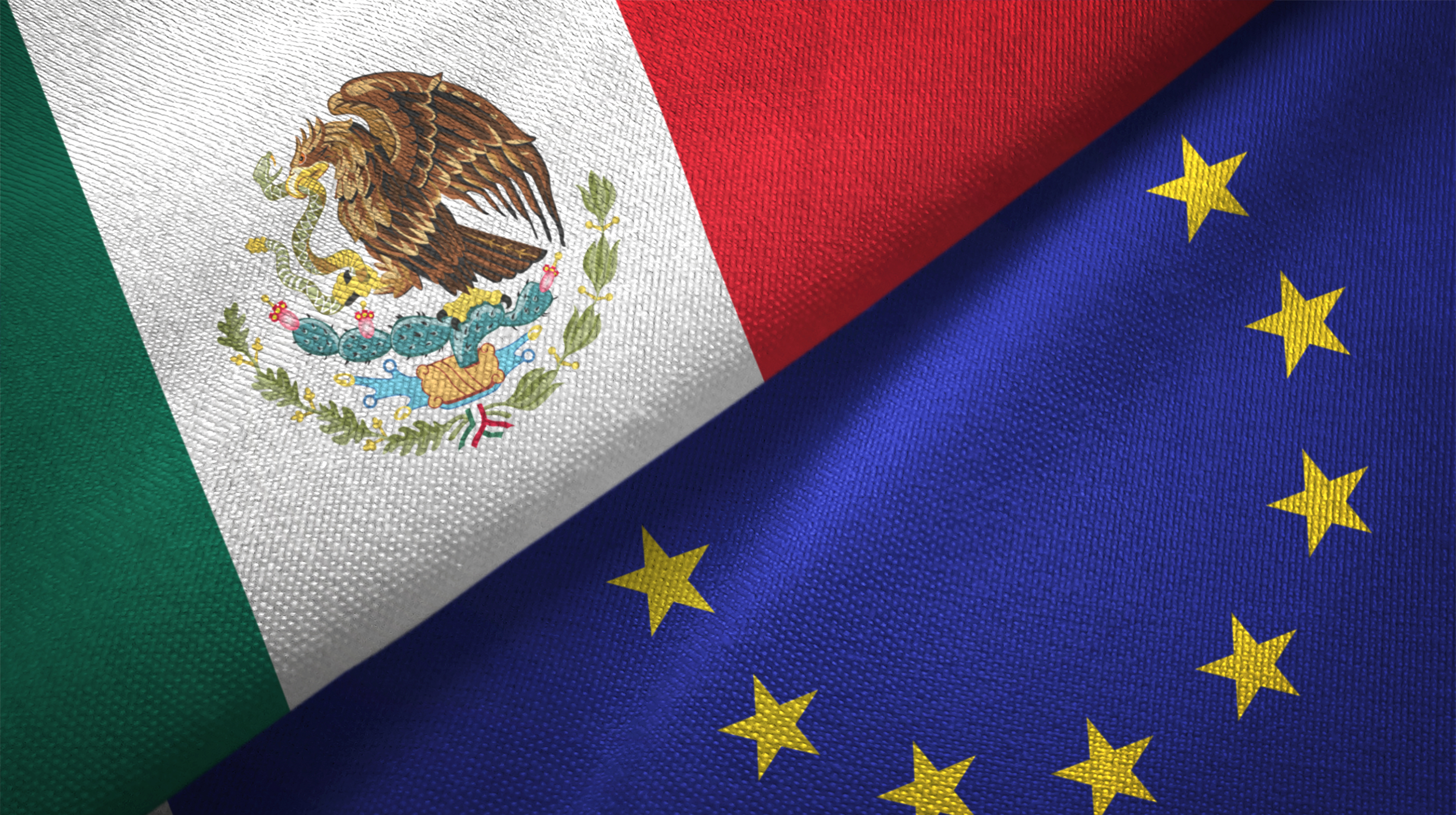
Mexico is currently facing a scenario of simultaneous pressures: the review of the USMCA amid an environment of aggressive tariff protectionism from Washington; the U.S. demand to limit trade and technology ties with China; and the domestic need to demonstrate that Plan Mexico remains active and represents a sustainable structural transformation. In this context, the Modernized Global Agreement with the European Union (EU) can become a strategic tool—an opportunity that must not be missed to strengthen ties with the world’s largest economic bloc.
The conclusion of the negotiations to modernize this Agreement, announced on January 17, 2025, just three days before Donald Trump’s return to the White House, was no coincidence: it was geopolitics.
A mature relationship that needed an update
The original Global Agreement, in force since 2000, was a milestone at the time: the first agreement to link the EU with a Latin American country through a framework that integrated trade, political cooperation, and dialogue across different levels. Since then, bilateral trade has tripled. In 2024, bilateral trade in goods reached €82.4 billion, and the EU became Mexico’s second-largest investor, with a cumulative €208.9 billion in 2023 (COMEXI, 2026). German, Spanish, French, and Italian companies have a deep presence in sectors such as automotive, pharmaceuticals, energy, and telecommunications.
However, more than two decades after its entry into force, the original agreement had become outdated. New issues on the global agenda—such as digitalization, the green economy, sustainable value chains, and the fight against corruption—needed to be addressed. The modernization and development of this “second-generation” agreement was inevitable. What took time was the political will to make it happen.
More than tariffs
The modernized agreement is not simply a tariff negotiation. Its scope is structural. For Mexico, the modernization of the agreement “is an instrument of foreign policy and economic development that expands the country’s international room for maneuver in an increasingly polarized geopolitical environment” (COMEXI).
In trade terms, more than 99% of exchanged goods will become tariff-free, benefiting Mexican exports such as avocado, berries, coffee, tequila, and mezcal (Huacuja and Lucatello, 2025), as well as manufactured and industrial products. For the European agri-food sector, the agreement opens access to a market where tariffs currently reach up to 45% on products such as eggs and pork, and 20% on potatoes, chocolate, and cheese. The agreement would also protect 232 EU spirits and 336 geographical indications (GIs) for wines, beers, and food products in Mexico (European Parliament, 2026).
European companies in sectors such as finance, digital trade, telecommunications, and transportation will also see expanded market access rights in Mexico.
Another relevant component for companies operating in both regions is the investment protection framework, through the introduction of more than thirty articles dedicated to dispute resolution in this area. These provisions expand the categories of potentially involved parties, establish permanent tribunals and appellate courts, and introduce a two-phase mechanism: one non-contentious phase and one judicial phase (Pasquali, 2024).
The context that makes it urgent: Plan Mexico, USMCA, and pressure from Washington
The government has launched Plan Mexico with the goal of strengthening the country’s productive base and reducing dependence on imports in strategic sectors. The logic is clear: if this is to be the engine of the coming years, Mexico needs to build domestic industrial capabilities—and, within that framework, European investment is exactly the type of capital that Plan Mexico needs to attract.
At the same time, Washington is pressuring Mexico to limit its trade exposure to China, particularly in sensitive sectors such as semiconductors, home appliances, and electric vehicles. In this landscape, the Global Agreement offers Mexico a structured response: diversify without confrontation, add partners without losing markets.
It is no small detail that approximately 80% of Mexican exports go to the United States, while the EU receives around 9% of the total. The modernized agreement is, in part, a bet on reducing that asymmetry.
What comes next: timelines, legal architecture, and what companies should do now
The path toward entry into force is not immediate. The agreement has a dual architecture: the Modernized Global Agreement itself (MGA) and an Interim Trade Agreement (iTA), which covers only matters under EU competence. This second instrument can enter into force more quickly, as it only requires approval from the Council of the EU and the European Parliament, while the comprehensive agreement continues its ratification process across the 27 national parliaments of EU Member States. Once the trade component enters into force, the iTA will expire and the MGA will fully take over.
For companies, this means there is a window of preparation that should not be wasted. Mexican companies should begin mapping their products against the new tariff conditions, identifying the European technical standards they will need to meet, and exploring access mechanisms for public procurement in Europe. SMEs, which have their own dedicated chapter, have a concrete opportunity to enter sustainable global value chains that were previously difficult to access.
For European companies already present in Mexico, or those evaluating market entry, the agreement offers a stronger architecture for making long-term decisions. President Sheinbaum has stated that nearly 2,000 German companies already have investments in Mexico, and that interest in continued investment remains high.
The real question is not whether the Agreement is convenient for Mexico. That has already been settled. The question is whether the country—companies, institutions, and state and federal governments—is prepared to take advantage of what the agreement offers.
Mexico now has its strongest argument in years for deepening its relationship with Europe. Using it well is a decision that can no longer wait.
Conclusion
The Modernized Global Agreement with the European Union has moved past the point of negotiation and entered a critical phase of operational readiness. For corporate leadership, the immediate priority is transitioning from a defensive market posture into an active assessment of new tariff conditions and European technical standards. The iTA framework provides a clear strategic runway, but companies that fail to map their products and supply-chain structures ahead of full implementation risk losing a vital first-mover advantage. Ultimately, this pact delivers Mexico's strongest argument for deepening global integration—utilizing it effectively is a corporate decision that can no longer wait.
For more information please contact:
Silvia Ardila
Regional Director LATAM
Silvia.ardila@speyside-group.com