
Indonesia’s economic policy is entering a new phase. President Prabowo Subianto has largely maintained the foundations established under Joko Widodo, whose decade in office was defined by large-scale infrastructure development, investment facilitation and an aggressive push for downstream processing of Indonesia’s natural resources. Under President Prabowo, however, these priorities are being combined with a more assertive role for the state in directing capital, managing strategic assets, and determining national development priorities.
Indonesia Is Entering a More State-Directed Economic Era
The government’s 2025-2029 development agenda places greater emphasis on food and energy self-sufficiency, industrialization and strategic investment, while the creation of Danantara has significantly expanded the state’s role in managing assets and financing priority projects. This shift is likely to have implications well beyond the current presidential term: many of these priorities are embedded in Indonesia’s longer-term development framework through 2045, the centenary of Indonesia’s independence.
The increased state-directed approach is also visible in how the government is increasingly linking investment policy to national strategic objectives. Rather than relying primarily on market-led investment, the Prabowo administration is seeking to channel capital toward sectors considered critical to national resilience and economic transformation, including food, energy, downstream processing and industrialization. These priorities remain prominent in the Government’s 2027 budget agenda, suggesting that they become embedded in the broader policy framework. At the same time, the government continues to pursue substantial private investment, including a cumulative investment target of around IDR 13,032 trillion for 2025–2029, meaning that greater state direction does not necessarily imply a retreat from private or foreign capital, but rather a stronger expectation that investment aligns with national priorities.
Prabowo’s Priority Sectors
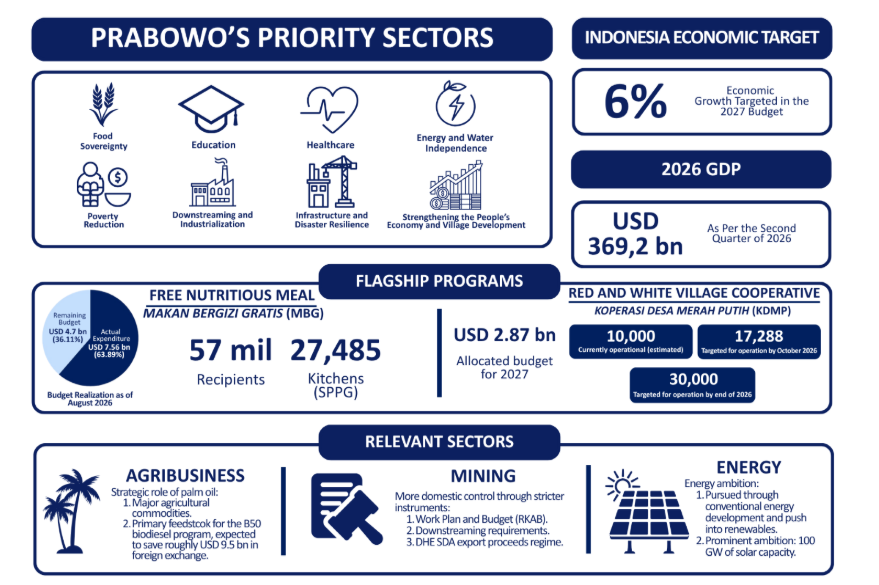
Prabowo’s economic agenda gives the state a larger role in shaping investment, production and consumption. This direction is reflected in the proposed 2027 State Budget, which sets out eight National Priority Work Programmes: food sovereignty; energy and water independence; education; healthcare; downstreaming and industrialisation; infrastructure and disaster resilience; strengthening the people’s economy and village development; and poverty reduction.
Several flagship initiatives illustrate how this agenda is being implemented. The Free Nutritious Meals program, or MBG, is being integrated into government spending on education and human-capital development, while the Red and White Cooperatives (KDMP) program is intended to strengthen village economies and local supply chains. At the same time, energy independence and downstream industrialisation remain central to the government’s economic strategy, with priorities ranging from renewable energy, including a 100 GW solar ambition, to higher-value industries such as electric vehicles, solar panels and semiconductors.
Delivering Prabowo’s economic agenda will require investment well beyond government spending alone. With economic growth targeted at 6% in 2027 on the path towards the government’s 8% ambition for 2029, private investment is expected to remain a key engine of growth. To support this ambition, Prabowo has consistently placed the development of Indonesia’s abundant natural resources at the centre of his economic strategy, with a strong emphasis on ensuring that more value is created and retained domestically.
In practice, three resource-linked sectors stand out in the government’s current policy and investment agenda:
- Agribusiness
Food self-sufficiency remains one of Prabowo’s most prominent priorities, keeping agriculture, plantations and related supply chains firmly in focus. Palm oil is particularly strategic, not only as one of Indonesia’s major agricultural commodities but also because of its expanding role in energy policy through the B50 biodiesel program.
- Mining
Indonesia continues to push for greater domestic control and value creation from its mineral resources. Increasingly active use of instruments such as annual mining work plan and budget approvals (RKAB), downstreaming requirements and the DHE SDA export-proceeds regime gives the government greater influence over production, processing and how export revenues are retained within the domestic financial system.
- Energy
Energy security is being pursued through both conventional energy development and an accelerated push into renewables. The government is expanding domestic oil and gas production while simultaneously promoting solar, geothermal, bioenergy and other renewable sources, including Prabowo’s ambition to develop 100 GW of solar capacity.
Turning these ambitions into investable projects will require significant capital and coordination across the public and private sectors. Increasingly, one institution sits at the intersection of these priorities is Danantara.
The Rise of Danantara Is Reshaping the Investment Landscape
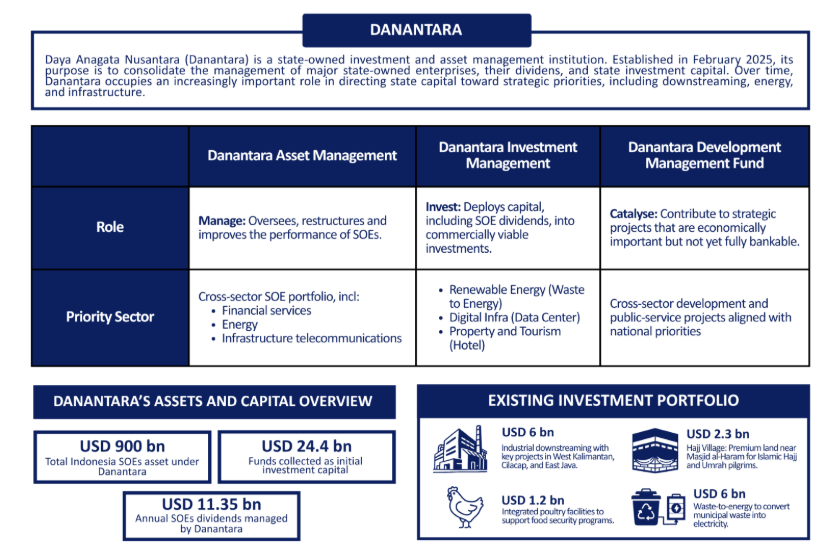
Danantara has rapidly emerged as a central institution in Prabowo’s state-directed economic model. Ever since established in February 2025, it consolidates the management of major state-owned enterprises (SOEs), their dividends and state investment capital, giving it powers not only over existing state assets but also over where capital is deployed to support strategic industries. The government has increasingly used Danantara to advance downstreaming, energy, infrastructure and other priority projects, including two rounds of groundbreaking for 26 downstream projects in 2026.
The mandate goes beyond conventional investment management. In 2026, the government established PT Danantara Sumberdaya Indonesia (DSI) as part of a new system for managing exports of strategic natural-resource commodities. Under the new framework, strategic commodity exports are channelled through DSI, alongside tighter rules governing foreign-exchange proceeds from natural-resource exports. The measures reflect a broader push to strengthen state visibility over export volumes, pricing and the foreign exchange generated from Indonesia’s natural resources.
Danantara’s role is expanding further through the Danantara Development Management Fund (DDMF), which is intended to prepare and finance long-term strategic projects that may not yet be commercially viable or suitable for direct state-budget financing. Together, these developments point to a broader centralisation of investment, SOE management and strategic-project development around Danantara.
For businesses, this creates a more complex operating environment. Greater centralization could provide clearer coordination for priority projects, but it also means that companies operating in strategic sectors increasingly need to understand how Danantara, sectoral ministries, regulators and SOEs interact, and where commercial decisions intersect with national policy objectives. At the same time, the concentration of capital and government attention around priority sectors is also creating new avenues for investment, particularly where private-sector capabilities align with Indonesia’s industrial and development ambitions.
Despite the Scrutiny, New Growth Engines Are Emerging
Several sectors continue to attract significant capital and create new opportunities for investors, particularly where commercial growth aligns with the government’s priorities on digitalization, industrial upgrading, energy security and domestic value creation.
Investment remained resilient in the first half of 2026, reaching IDR 1,010.6 trillion, up 7.2% year-on-year, with foreign investment accounting for just over half of the total.
Several sectors stand out.
- Data centres and digital infrastructure are benefiting from Indonesia’s expanding digital economy and rising demand for artificial intelligence infrastructure. In Jakarta alone, transportation, warehousing and telecommunications accounted for IDR 54.4 trillion in investment during the first half of 2026, while the broader services category, which includes web hosting and data centres, attracted IDR 43.6 trillion.
- Manufacturing and industrial estates also remain important areas of growth as Indonesia seeks to deepen domestic supply chains and attract higher-value production. Downstream industries, meanwhile, remain among the government’s strongest investment priorities, with the model increasingly expanding beyond minerals and energy into agriculture and fisheries.
- Renewable energy is another emerging opportunity as the government seeks to strengthen energy security while accelerating investment in solar, geothermal and other cleaner sources of power.
For investors, however, opportunity increasingly comes with expectations. Projects that demonstrate local value creation, technology transfer, employment, stronger domestic supply chains or alignment with national strategic priorities are likely to find a more receptive policy environment. In this context, commercial strategy and government engagement increasingly need to be developed together rather than treated as separate workstreams.
Understanding Where Power Sits
As Indonesia’s economic policy becomes more centrally coordinated, understanding the formal decision-making structure alone is no longer sufficient. For businesses, it is increasingly important to identify not only which institution has statutory authority, but also which officials coordinate across government, shape presidential priorities and help resolve implementation bottlenecks.
- At the center is President Prabowo Subianto, whose economic agenda is implemented through a relatively concentrated group of senior officials.
- Rosan Roeslani occupies an especially important position for investors, serving as Minister of Investment and Downstream Industry while also leading Danantara, placing him at the intersection of investment facilitation, downstream policy and strategic state investment.
- For energy, mining and natural-resource projects, Minister of Energy and Mineral Resources Bahlil Lahadalia remains central, particularly as the government tightens oversight of mining licenses while continuing to pursue downstream development and energy security.
- Coordinating Minister for Economic Affairs Airlangga Hartarto plays a key role in coordinating cross-ministerial economic policy, particularly on macroeconomic, trade and investment-related issues.
- At the presidential level, Cabinet Secretary Teddy Indra Wijaya plays a central coordinating role around President Prabowo’s agenda. He organizes presidential meetings and priorities, communicates the President’s directives, and follows up with relevant ministers and senior officials on strategic programs.
- There is also the so-called “Hambalang Boys” group, an informal term commonly used to describe a group of younger loyalists to Prabowo who have been working closely with him even before his presidency and have since taken on influential positions across government and state institutions. Figures frequently associated with this circle include Foreign Minister Sugiono, State Secretary Prasetyo Hadi, Vice Minister of Communication and Digital Affairs Angga Raka Prabowo, and Sudaryono.
This is not an exhaustive list, as a wide range of ministers, regulators and senior officials may be more relevant depending on the technical issue, sector or project involved. However, the figures highlighted above represent some of the individuals closest to President Prabowo’s political and policy coordination. For businesses, this central circle should be understood alongside the sector-specific stakeholders responsible for regulation, implementation and project delivery.
Conclusion
What Does This Mean for Businesses?
For businesses and investors, navigating Indonesia’s increasingly state-directed environment requires a more deliberate, layered and long-term approach to government engagement.
- Engage before issues emerge. Stakeholder engagement should not begin only when a regulatory, licensing or operational issue arises. Companies should build institutional credibility early through regular dialogue, consistent presence and a clear demonstration of how their investment contributes to national and local priorities. Government relations should not be limited to individual permits, approvals or project-specific requests. Businesses need to understand the political and economic priorities shaping government decisions and position their projects within that broader policy context.
- Map stakeholders based on their influence. Identifying the responsible ministry or regulator is only the first step. Companies should also understand who coordinates across institutions, influences implementation and can help resolve bottlenecks when issues cut across multiple agencies.
- Build relationships across multiple levels of government. Effective engagement increasingly requires coordination from the presidential and coordinating level through sectoral ministries, investment institutions and regulators, while maintaining strong relationships with provincial and district governments. Local stakeholders remain critical to implementation, community acceptance and operational continuity.
- Treat government relationships as a long-term investment. Successful engagement in Indonesia is built over time. Companies that maintain credible, consistent relationships and demonstrate alignment between commercial objectives and Indonesia’s development priorities will be better positioned to navigate policy changes and identify emerging opportunities.